
Los Angeles-based Standard Audio was founded by esteemed engineers Ian MacGregor and Thom Flowers. Unable to find commercial products to achieve the colors and sounds they were seeking, they set out to make their own equipment. These designs are rooted in obscure devices from the past but modernized with contemporary workflow features and vastly improved noise characteristics and reliability.


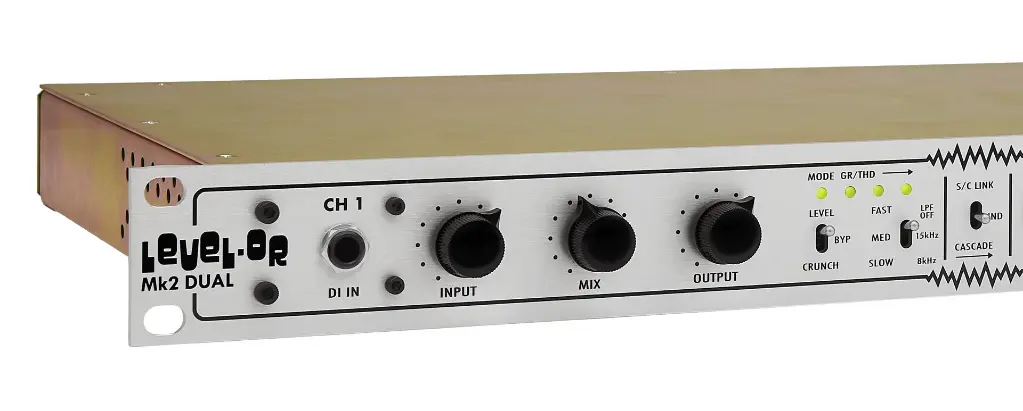
Level-Or Mk2 Dual
Rackmount Limiting And Harmonics - To The Extremes
The Standard Audio Level-Or Mk2 Dual is a two channel JFET limiter and harmonic distortion processor in a single space, 19” rack. The design is based on the 500 series format Level-Or Mk2 with some additional features & functions.
The Level-Or Mk2 Dual includes all the features and improvements of the Mk2 500-series module (lower noise, bypass switch, instrument DI) PLUS a mix knob, stereo linking, and a unique Cascade Mode. The unit includes an over-designed internal power supply and a rugged, corrosion- resistant steel chassis along with an aluminum front panel.
The core of each Level-Or Mk2 Dual channel is a JFET transistor-based limiter, originally inspired by the Level-Loc PA limiter. In Level mode, this section acts as an extremely high ratio limiter. In Crunch mode, this section uses (and abuses) a series of Class A discrete transistor stages to provide anything from subtle harmonic enhancement to complete destruction of the audio signal.
Those familiar with the 500 series version will notice the addition of the mix knob as well as the center Link/Cascade toggle switch. The mix knob allows the engineer to blend in the dry, un-processed input signal with the processed “Level/Crunch” signal. This allows for much more control over how aggressive or subtle the effect is through the unit.
The center Link/Cascade switch has 3 positions: S/C LINK, IND, and CASCADE. When set to IND (or independent), the two channels are separate. When set to S/C LINK, the JFET limiter sidechains are linked together, vastly improving Left/Right balance on stereo sources. This only applies when both channels are in Level mode.
When set to CASCADE, the output of Channel A is fed into the input of Channel B and the unit becomes a mono processor with both channels in series. All the controls are still independent – it is just like you have patched the output of one Level-Or channel into the input of a second. Along with the mix control, this allows for a ton of flexibility: limit first/then distort, distort first/then limit, distort twice, limit twice.
The function of the speed switch depends on whether the unit is in Level or Crunch mode. In Level mode, the speed switch controls the release time of the limiter, with FAST, MEDIUM, or SLOW options. In Crunch mode, the speed switch controls a variable low pass filter in the audio path. This is useful to control harshness from high frequency harmonics that can be a side effect of harmonic distortion. The speed switch offers 3 low pass modes: OFF, 15kHz, and 8kHz.
The rear panel of the unit contains line-level XLR input and output connectors, a ground lift switch, and an IEC inlet plus fuse for power.
“At a Glance” (features):
- Dual Channel, 19” 1U format
- Same features as Level-Or Mk2 plus Mix Knob
- Limiter Sidechain Link
- Serial channel CASCADE mode
- Line Level balanced input with relay bypass
- Line Level Output capable of driving balanced 600-ohm loads
- Discrete JFET Limiter with Level and Crunch operating modes
- Instrument DI on front panel
- Universal Power Supply, 90-240VAC @ 50/60Hz
- Sturdy, corrosion resistant steel chassis
“Recommended Uses”
- Smash drum room mics to pull out room sound and add excitement (in stereo!)
- Add grit and drive to bass guitar or synth
- Blend in crunch mode with Mix knob to add extra character to vocals
- Add weight and attitude to close drum mics and acoustic instruments
- Process stereo busses directly using mix knob to dial in just the right amount of character
- Use in cascade mode on mono sources to unlock unique serial processing


Level-Or Mk2
500-Series Limiting And Harmonic Distortion
After 10 years of production and over 1,000 units sold, Standard Audio decided that it was time to release a new version of the Level-Or that retains the sound and vibe of the original, but includes improvements and features suggested by our customers over the years.
For those not familiar with the original Level-Or, it is an aggressive JFET limiter and harmonic distortion generator inspired by the Level- Loc PA limiter from the 60s and 70s. The Mk2 version takes the original concept to a new level with improved performance and added features making it an extremely versatile studio tool.
FEATURES:
LOWER NOISE – Due to the aggressive nature of the circuit, a common issue with the
original Level-Or was the noise present in Level mode. With extensive R&D and listen testing,
we found a way to lower the noise considerably while remaining true to the tone and vibe of the original circuit. As a result the Mk2 noise floor is 12-15dB BETTER than the original Level-Or.
MODE SWITCH – Switches between Level, Crunch, and Bypass modes. - Bypass Mode: We have included a relay based true-bypass.
- Level Mode: Sound of the unit is dominated by an extreme JFET limiter. Use this mode to slam, squash, and pummel your audio signal.
- Crunch Mode: Sound of the unit is dominated by distortion generated from a series of discrete transistor based, Class A amplifier stages. Use this mode to provide subtle saturation and harmonic enhancement all the way to heavier distortion and outright destruction of your audio signal.
LED INDICATOR – A dual color LED serves two functions. When the unit is in Crunch mode, the LED is red and in Level mode, the LED is green. While in bypass, the LED is off. While in Crunch or Level modes, the LED will get brighter according to how much compression (Level) or THD (Crunch) is occurring. This can provide helpful feedback to the engineer.
SPEED SWITCH – Formerly, the speed switch provides two release times (fast/slow) while in Level mode, and was un-used in Crunch mode. We have expanded to a 3 way switch and added functionality that changes, depending on mode.
- Level Mode: There are now 3 release times, FAST, MED, and SLOW. The FAST and SLOW settings are the same as the original, with the added medium time constant in between.
- Crunch Mode: The speed switch now controls a 3 way low pass filter on the output. This can be very useful for reducing harsh, higher harmonics while distorting. When set to FAST, the filter is bypassed. When set to MEDIUM, the LPF is 15kHz. When set to SLOW, the LPF is 8kHz.
INSTRUMENT DI - The original Level-Or had a line input via a front panel 1/4” jack. While useful for interfacing with a drum machine or synthesizer, it was not useful for guitar, bass, or any other instrument level source. On the Level-Or Mk2, we have changed this to an instrument-level DI input.
DI MODES - The unit detects when a 1/4” jack is inserted and switches over to the DI input.
- DI Bypass Mode: When the DI is used, putting the unit into Bypass mode sends the clean DI signal to the output of the unit. The unit functions as a clean DI with gain, no external amplifier required. The output control is active to adjust level as needed.
- DI Crunch Mode: The DI signal is sent through the input gain stage and all controls work as normal including the filter switch.
- DI Level Mode: The DI signal is sent to the limiter and all controls work as normal.
*It is possible for the user to configure the front panel 1/4” input to be configured as a line input if desired.
FULLY ENCLOSED STEEL CHASSIS - A 100% enclosed steel chassis reduces the chance of electrical interference or noise from adjacent modules, gear, etc.
RELIABILITY - After delivering over 1,000 original Level-Or modules out into the world, the reliability of the design has been incredible. The Level-Or Mk2 follows the same robust design approach and attention to detail.


STRETCH
500-Series Multiband Dynamic Sweetening
The Standard Audio Stretch is a 500 Series, multi-band compression/dynamics unit based on noise reduction units from the 1970s and 1980s. The Stretch emulates the sound of these classic units in their respective “encode” modes. However, the Stretch adds new features to employ this old trick in multitude of new ways.
The Stretch allows the user to use the 4 separate frequency bands of compression in different combinations to sculpt or accentuate individual tracks or a mix in ways no other compressor or EQ can achieve. The onboard Mix Control dials in the perfect amount processing with the original dry signal. Use the Stretch to add air to vocals, add sparkle to acoustic guitars, add sheen to overheads, add punch to drums, make bass tracks thunderous, or even create additional depth and detail on the whole mix bus. The possibilities are endless!
Features:
- Four frequency bands that are individually processed
- LF Band: 20Hz - 110Hz
- MF Band: 110Hz - 3kHz
- HF3 Band: 3kHz - 20kHz
- HF9 Band: 9kHz - 20kHz
- Filter/Compression pushbutton: lets the user cycle continuously through 7 different filter combinations. Orange HPF and LPF front panel LEDs indicate the different combinations
- 100% analog signal path
- Highest quality, high reliability amplifier circuit design. High quality filter capacitors for filter stages
- Engage pushbutton: Enables/Disables true hard-wired relay bypass circuit. Unit is engaged when pushbutton LED is lit
- Filter/Compression pushbutton LED: Indicates when any of the active filter stages has reached 2dB of compression
- Input Control: Allows the user to set the gain structure through the unit so that the desired amount of compression is occurring
- Output Control: A post-mix circuit output level control allows the engineer to set the output level to DAW/Tape without altering the mix blend
- Mix Control: Blend the Stretch signal in with the un-processed input signal to vary the amount of effect desired
Please Note: For some 500 series based consoles (API 1608 for example), it may be necessary to connect the Stretch via unbalanced output to interface with the console properly. We have provided a jumper (labelled J2) on the Stretch PCB that lets the engineer choose the output configuration. Using the provided shorting plug, connect pins 2 & 3 for balanced operation (factory default). Connect pins 1 & 2 for unbalanced operation. Please do not hesitate to contact us if you have any questions.